USDC or USDT — Which Stablecoin Suits Your Business?
3 mins
AI automation is transforming the way businesses operate, from streamlining workflows to enhancing decision-making. In this article, we explore the latest trends, innovations, and real-world applications that are reshaping industries worldwide.
Introduction
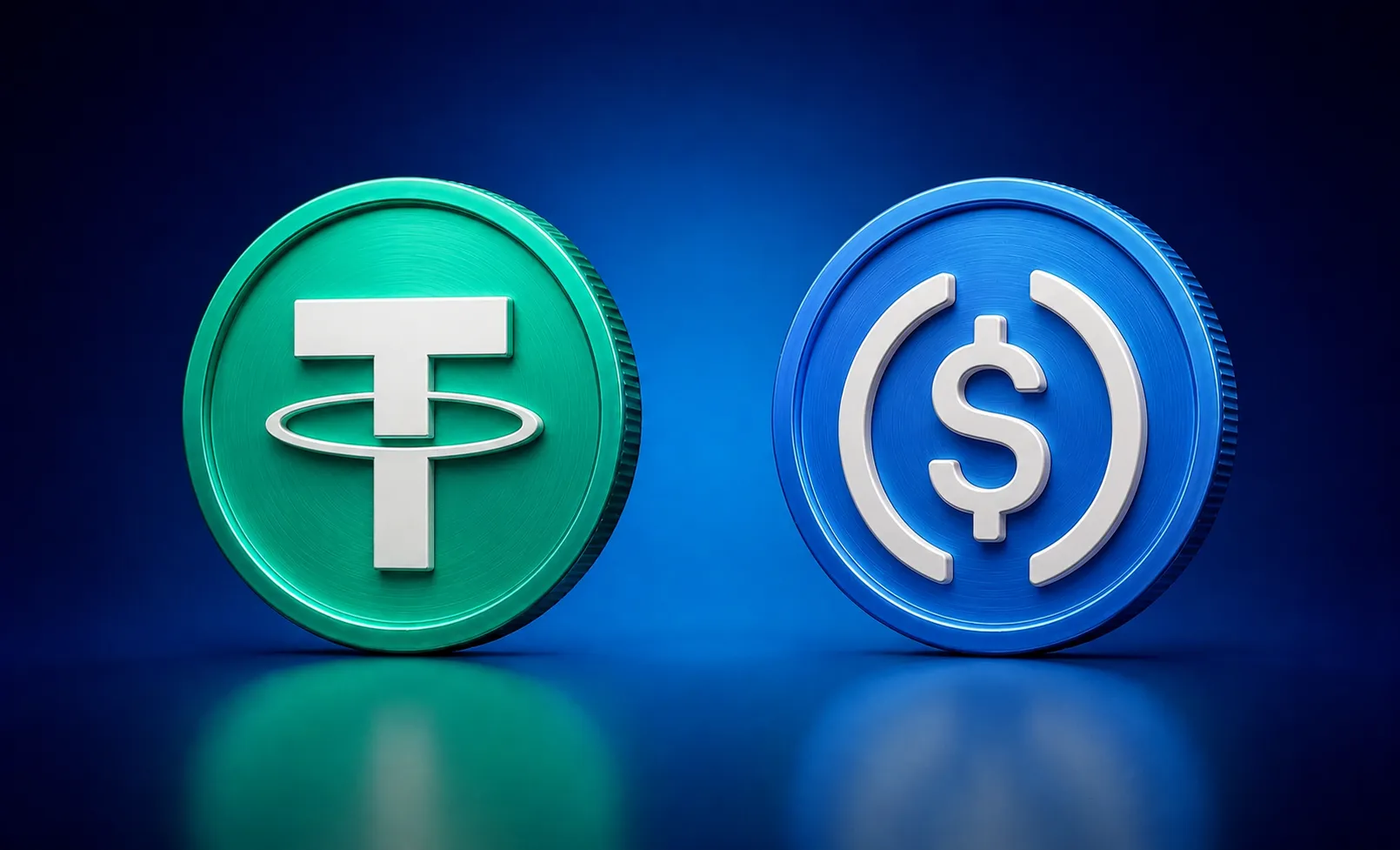
Compare Tether (USDT) and USD Coin (USDC). Learn about their reserves, regulatory compliance (MiCA) and which stablecoin might fit your trading or DeFi needs. Stablecoins can be seen as workhorses that bridge traditional finance and the digital asset market. Pegged to fiat currencies like the US dollar, they offer (relative) price stability against the volatility of assets like Bitcoin and Ether. This article explains the key differences between the top stablecoins by market cap, Tether (USDT) and USD Coin (USDC).
What is Tether (USDT)?
Launched in 2014, Tether is the oldest and largest stablecoin currently in circulation. It functions as a digital dollar that could move across blockchains with the same ease as BTC, while being deeply integrated into global stablecoins in DeFi protocols and centralised exchange trading pairs.
A prime utility of USDT is its liquidity. When you buy USDT or USDC, you’ll find that USDT tends to offer the highest number of trading pairs. This makes it a ‘default’ currency for traders needing to move in and out of positions quickly, particularly in emerging markets and offshore trading environments.
USDT is available on more than a dozen blockchains – including Ethereum, Tron, Solana and Cronos – and is minted or burned based on redemptions.
While USDT has long dominated the market, its lack of regular, independent audits has raised transparency concerns and led to scrutiny from regulators.
What is USD Coin (USDC)?
USDC was launched in 2018 by the Centre Consortium. Like USDT, USDC maintains a 1:1 peg with the US dollar, but it differentiates itself through audited reserves held in a dedicated SEC-regulated money market fund, overseen by BlackRock.
Issued natively across more than 18 blockchains — including Ethereum, Solana, Avalanche and Polkadot — USDC powers everything from on-chain payments to institutional DeFi. Its Cross-Chain Transfer Protocol (CCTP) enables native burning and minting of USDC across supported chains, reducing (but not eliminating) bridge risks.
USDC may be favored by fintech platforms, regulators and institutional traders for its compliance-first approach, plus how it has become a publicly listed company. However, it lags behind USDT in total volume and global market penetration, especially in jurisdictions where decentralised issuance models are preferred.
Reserves and transparency: How are they backed?
Stablecoins maintain their value through reserves that back the tokens in circulation. The composition and reporting of these reserves are where the two assets differ most.
Tether’s reserve structure
Tether’s approach is one of a diversified reserve. While a significant portion is held in US Treasury bills, Tether also allocates a percentage of its backing to other assets like physical gold and Bitcoin. Tether provides quarterly ‘attestations’ conducted by BDO, which offer a snapshot of the assets backing the tokens.
In early 2026, Tether completed its first-ever full financial audit conducted by a ‘Big Four’ accounting firm.
The exact composition may change over time. You can check Tether’s reserve reports for the latest updates.
Circle’s reserve structure
Circle (USD Coin’s issuer) maintains a more traditional reserve composition for USDC. Its reserves consist almost exclusively of cash and short-duration U.S. Treasuries.
USDC’s reserves are held in the Circle Reserve Fund (managed by BlackRock), which has short-term maturity periods. The reserve strategy is conservative and transparent, optimised for capital preservation and liquidity.
Circle publishes monthly reports through Deloitte, which makes for a higher frequency of transparency compared to USDT.
Stability and historical de-pegs
Maintaining a 1:1 peg is the central requirement for these assets, yet both have faced moments of market stress.
USDC’s all-time high and the 2023 SVB event
USDC reached an all-time high of above $1.10 in January 2021 amid a broader market surge. However, it faced its greatest test in March 2023, falling to $0.88 after the collapse of Silicon Valley Bank (SVB), where a portion of its cash was held.
The peg was restored quickly after the US government stepped in to protect depositors, but it highlighted ‘banking risk’ within compliant structures.
Tether’s volatility in 2015 and 2018
In March 2015, USDT reached an all-time low of approximately $0.57 during its early, less liquid years. Conversely, in July 2018, USDT experienced a rare spike, briefly trading above $1.70 on some exchanges due to a sudden imbalance in demand.
The arbitrage mechanism
Both issuers maintain stability through ‘mint and burn’ mechanics. If the price on an exchange fluctuates, market participants can buy the undervalued token and redeem it for exactly $1 from the issuer. This profit motive keeps the price anchored to the dollar.
Regulatory status: MiCA and beyond
At the time of writing, the 2026 landscape is heavily influenced by the MiCA regulation in the European Union. This framework sets strict rules for ‘asset-referenced tokens’ and ‘E-Money tokens’.
Under these laws, issuers must be authorised within the EU to offer their stablecoins to retail users. Circle has positioned USDC as a regulated ‘E-Money Token’, allowing EU-regulated exchanges to continue offering it.
In contrast, some exchanges have restricted or delisted USDT for EU residents because it doesn’t currently carry the same MiCA-compliant status. This has created a geographical split where USDC is the standard for European retail users, while USDT remains the liquidity leader in other global regions.